

Make / Model Search
OptionsCar reviews - Toyota - RAV4 - Old vs. NewToyota modelsOverviewWe like Quiet, smooth riding, more fuel efficient, the ‘B’ button returns, adequate feature list, finally gets adult-size panoramic roof Room for improvement Hard plastic cabin looks cheap, dash design not up to class levels, leather feels fake, 95RON adds to costs, price is a big ask RAV4 polished with incremental improvements but no big changes27 May 2026 By NEIL DOWLING Overview
TOYOTA’S popular white-goods model, the RAV4, enters 2026 with a bit more of everything except a discount sticker, ready for another fleet of buyers who purchase on brand and peer impressions and the heartfelt advice of their favourite influencer.
And, with the sixth-gen RAV4, those buyers won’t go wrong. The latest Toyota mid-size SUV is again a great package capable of pleasing cost-conscious motorists who value reliability and the (high) potential of a solid resale price.
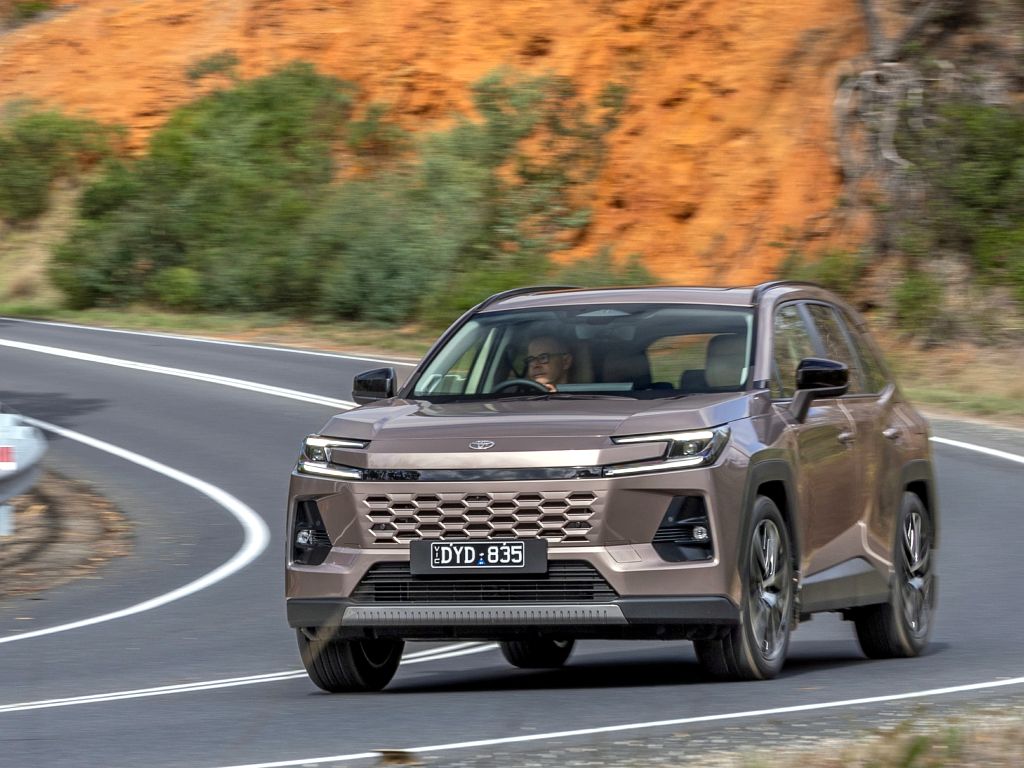
The 2026 version is heavily based on the previous model (and is exclusively a hybrid) and aside from the grille and tail treatment, doesn’t contrast visually with its predecessor – a fact that makes the transition from last year’s edition to the new one so much easier for Toyota owners.
Again, it’s effectively a Camry with a boxy body. But the SUV styling and cabin treatment put it in another class – families.
New for 2026 are body panel changes – including the less commercial-grade nose than before – while the passenger cell (including windscreen angle, side windows, door openings, etc) remains the same.
Inside it’s a different story, with some welcome changes – lower dash line, superior infotainment unit, digital instrument panel – and some less so, including the acres of hard dash plastics, some misplaced switchgear and (in the Cruiser version tested $60,340+ORC) leather trim that does an exceedingly good interpretation of vinyl.
The gear shifter is now a ‘shift-by-wire’ unit (Cruiser) that revisits early Prius models, and also brings back the Prius’ ‘B’ mode to the selection. This refers to ‘B’ for battery and, when engaged in situations such as descending a long hill, increases the aggression of the regeneration to introduce more charge to the car’s battery.
New owners will have to cough up more for the latest RAV4 in purchase price and for fuel, as Toyota now demands 95RON petrol, up from the previous model’s cheaper 91RON.
That’s despite the hybrid’s petrol engine delivering 20kW less power, so you’re effectively paying more for ostensibly less performance.
And you’ll pay more for the car. The Cruiser AWD tested here is $60,340 (plus on-road costs), up $5930 on the previous model which had almost all the same bells and whistles and even drove just as well (I know, this review put it up against a 2025 version).
None of this will probably affect a repeat Toyota buyer. The latest RAV4 is pretty good and highly recommended for viewing if you’re in the market.
It would have been unimaginable for this latest RAV4 to be much different from the old one. Back-to-back with a 2025 RAV4 Cruiser hybrid – the same spec as the test car – showed similarities, from opening the door and taking a seat right through to driving off.
The ‘shift-by wire’ gearshifter is new (although feels and looks like an early Prius) with the Cruiser getting this exclusively, along with an integrated electric park brake. The rest of the variants have the traditional shifter.
More noticeable is the dashboard which sits lower, allowing better vision ahead. Dash design follows Minecraft’s blocky look with an array of angles, tiers and shapes clipped together to form the dash.
It’s not as clean as the previous model and not as attractive as most rivals, particularly the latest Chinese batch of cars with smooth and fluid dash shapes. This also creates lots of bitsy dash pieces, most being in hard plastic that deters from the RAV4’s class and price.
The digital flat screen for the driver replaces the previous binnacles set with analogue instruments.
The centre monitor is more pronounced, clearer, brighter and topped and tailed with two smaller manual functions: the drive mode and EV button (left) and the three-mode off-road switch (trail, snow and normal) on the right. Both these buttons are dominant features of the dash yet are odd choices given most drivers would rarely, if ever, engage these functions.
There are some smaller buttons for things like front and rear window demist and HVAC (heating, ventilation and air conditioning) temperature control along the bottom of the centre screen. Camera view, hill descent and traction control buttons are lower down, alongside the storage bin together with two USB-C plugs.
Compared with the previous RAV4 which had large round dials that fell easily to hand, the latest HVAC switchgear is less easy to access – especially for the driver on the road – and so requires some familiarisation.
The storage bin between the front seats is double hinged so can be accessed by either front occupant. The convex lid can also be removed, flipped over and its concave underside then becomes a handy tray.
Nothing strange here: It all works well and fits the family-centric target buyer.
The RAV4 Cruiser gets two wireless phone chargers in the centre console, beneath the touchscreen, followed by a storage area. So there’s plenty of places to store personal items.
Air vents are well located and big enough to crush a summer heatwave, including two for the rear occupants along with controls.
Bottle holders in the doors are bigger than the outgoing model, and there appears to be more room available for cups in the two holders alongside the gear shifter.
There’s plenty to like about the support and shape of the seats, although there’s less side bolstering than the previous model RAV4.
Toyota lists the upholstery as leather “accented” and although it looks great with its perforated finish in the cushion and seat rest, it feels less like leather and more like vinyl. No arguing about the comfort, though.
Front seats get heated and ventilated functions, with the heaters now extending to the outside rear seats … making the kids love the car even more.
RAV4s now get Toyota’s Arene software which links the car to over-the-air updates, can remotely upgrade and fix multimedia errors, and allows the integration of future functions including AI.
There's also Google Voice with voice command that works with navigation, audio, climate and vehicle functions.
Music streaming doesn’t need phone or app pairing and uses services such as Spotify directly from the multimedia system via the RAV4’s inbuilt data communication module (DCM).
New is an embedded drive recorder that Toyota says uses the vehicle’s active safety cameras to record in a continuous 90-minute loop while driving, although short clips can be manually triggered.
Cameras also record automatically if the car detects a crash or an airbag is deployed. Toyota said this essentially provides RAV4 owners with an inbuilt dashcam and that owners can transfer clips to a USB stick.
It also gets standard wireless Apple CarPlay and Android Auto compatibility for the first time, integrated with the sat-nav system, voice command and the audio. In the Cruiser, the audio is a nine-speaker JBL unit, with good sound quality.
Aside from all the tech to play with, I like the volume control button at the centre of the console, accessible by both driver and front passenger.
Such a simple thing but it’s weird that some rivals not only don’t offer this to the passenger, but often bury the volume control in the touchscreen.
For 2026, it comes with the next generation of Toyota Safety Sense safety features including the autonomous emergency braking (AEB), pre-collision warnings and mitigation systems, active cruise control, front and rear cross traffic alert, lane-keeping and lane-changing assist, blind-spot monitor, eight airbags and automatic high beam.
New stuff includes a more reactive AEB for earlier detection of vehicles crossing perpendicularly at intersections, and enhanced pre-collision warning and braking to improve detection of an impending accident and to avoid a collision.
Front cross traffic alert, to detect crossing vehicles when forward exiting a parking space or driveway, is a new addition.
Capped-price servicing is available for five years or 75,000km (whichever comes first), at a cost of $325 per service over intervals of 12 months/15,000km.
Roadside assistance is for 12 months, extended each time the car is serviced at a Toyota dealer up to a maximum of five years.
Driving impressions
Don’t think you’re losing out because the 2026 RAV4 has 20kW less power than last year’s model. There’s no discernible difference so ignore the statistics or anyone who reckons the new car is, comparatively, gutless.
So ignoring the data for a minute, the RAV4 remains what it’s always been through the previous five generations – a very easy car to drive.
In fact, it’s almost a brainless decision to buy this after a road test because pretty much everything about the car makes sense, especially the fact that it’s a fuel-efficient hybrid.
It uses its electric motor(s) for reversing, automatically starting and engaging the petrol engine mostly when accelerating.
Toyota has reduced noise, vibration and harshness (NVH) for 2026 but it’s still not the quietest engine around and gets grumbly and feels a bit harsh when pushed.
Performance is good, with quick-ish acceleration and a seamless change between motor and engine operations.
Steering is precise and well weighted, with good ride comfort reflected by the way the car absorbs bad road bumps without any ‘crashing’ or hard noise intrusion.
The RAV4 also corners and handles well, although you know it’s an SUV and not one that takes to brisk cornering, where it displays typical understeer.
Now about those power figures. There’s now 143kW (previously 163kW) directly as a result of the Australian New Vehicle Efficiency Standards (NVES).
To show how NVES bites into the new-car sector, no other market loses power for the RAV4 in 2026 and, in fact, the US AWD version now has 176kW. By the way, more power (up to 227kW) arrives next month with the plug-in hybrid RAV4.
Because of this power reduction for Australians, the RAV4 now gets better fuel economy and, importantly, lower emissions to appease NVES.
The 2025 model tested alongside averaged 5.6 L/100km (Toyota claimed 4.8L/100km). This review of the 2026 version averaged 5.1L/100km (Toyota claims 4.6 L/100km).
These are small differences but it’s important that the test showed the EV was engaged quicker and more often than in the outgoing RAV4.
Technically, the new RAV4 Cruiser AWD has 143kW combined, with the 2.5-litre petrol engine delivering 105kW at 4800rpm and torque of 221Nm at 3200-3600rpm. Toyota doesn’t combine the engine and electric motor torque figures because they’re not compatible.
The previous model’s 2.5-litre engine had 131kW at 5700rpm, and 221Nm of torque at 3600-5200rpm.
So there’s a big change in the petrol engine’s output and, again, the data doesn’t relate to the driving experience because there’s similar power available at the more usable (1500-3000rpm) rev range in both the 2025 and 2026 versions.
There’s also been an upgrade to the electric motor outputs, with the front motor now 100kW (up from 88kW) and 208Nm; and the rear electric motor staying the same as the 2025 at 40kW/121Nm.
Toyota hasn’t a crash rating for the RAV4, despite the model being almost identical to its predecessor.
The car-maker missed both Euro NCAP and Australia’s ANCAP smash test exercises and so will continue until next year before getting a chance to hit the wall, albeit under a new and stricter testing regime.
The previous RAV4 (2019-2025) is rated as a five star, picking up top safety marks for adult occupant (93 per cent); child occupant (89 per cent); vulnerable road user (85 per cent); and safety assist features (83 per cent).
The latest RAV4 is pretty good and highly recommended for viewing if you’re in the midsize family SUV market.
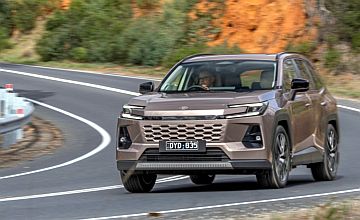 Read more23rd of April 2026  Toyota RAV4 sales to be 30 per cent PHEVToyota Australia exec expects PHEV to account for 30 per cent of total RAV4 sales16th of April 2026  Toyota not worried about Chinese competitorsLocal exec says he is not worried about growing number of Chinese SUV rivals, focus on RAV416th of April 2026  Initial Toyota RAV4s to be unrated by ANCAPPre-updated Toyota RAV4s will never receive an ANCAP score, leaving Aussie buyers in doubt |
OptionsClick to share
|


 Alfa Romeo
 Abarth
 Audi
Audi Aston Martin
 BMW
BMW Bentley
 Ferrari
 Chevrolet
 Ford
Ford Fiat
Fiat GWM
GWM Foton
Foton Hyundai
 Honda
Honda Jaguar
 Isuzu
Isuzu Kia
Kia Jeep
Jeep Land Rover
 Lamborghini
 Maserati
 Lexus
Lexus McLaren
 Mazda
Mazda MG
MG Mercedes-Benz
 Mitsubishi
 Mini
Mini Peugeot
 Nissan
 Ram
Ram Porsche
 Rolls-Royce
 Smart
Smart Skoda
Skoda Suzuki
 Subaru
 Toyota
 Tesla
Tesla Volvo
Volvo Volkswagen
 Zeekr
Zeekr

Connect with us


Facebook Twitter Instagram