


Make / Model Search

OptionsCar reviews - Mazda - BT-50 - BossMazda modelsOverviewWe like Value for money, stylish exterior and interior, good cabin space, predictable performance and handling, strong payload and tow rating Room for improvement Fuel consumption, noisy engine, light steering Pretty ute packs Isuzu muscle20 Jul 2026 By NEIL DOWLING Overview
IT’S hard to get too enthusiastic about a ute but at least Mazda takes it up a notch with a body design that looks almost attractive.
Even on the inside, the BT-50 is functional while looking neat. Almost car-like, said one onlooker.
That, of course, is where any similarity with one of Mazda’s passenger cars ends. The BT-50 is a product of Isuzu and is based on its tough D-Max ute series, of which it supplies different bodies and models for Mazda to rebadge.
The process works. The BT-50 is equally as tough as the D-Max so is certainly up to the job of hauling, perhaps less so for the art of transporting kids to school. Don’t laugh: there’s a lot of that going on.
Within its range of BT-50s, Mazda’s latest is the Boss. People with memories that recall days of nice US presidents will remember the Boss name as being allocated to a variant that added a bit of extra equipment for not much more money.
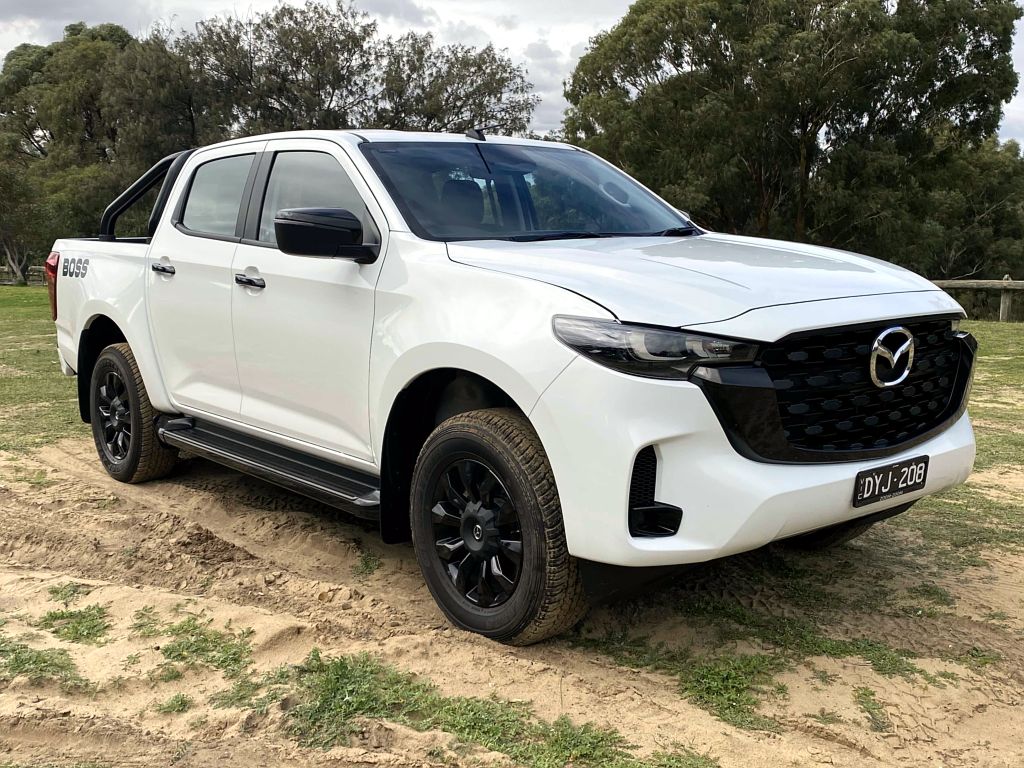
It’s back. Now the Boss stands for black-painted bits like door handles and mirrors, plus the addition of a black-painted sports bar and side steps, and a tub liner.
The BT-50 Boss 4WD costs $59,990 including drive-away costs (less in some states). This is around $3000 more expensive than the XT on which it is based, so the extra gear gives this version a bit of extra value.
It also has the top-tier drivetrain of the big 3.0-litre diesel, six-speed auto and 4WD system, along with 17-inch wheels and a rear locking differential. All these are pretty much the ‘must have’ items in the ute sector.
There’s also the 3500kg braked tow rating and 1034kg payload, and 1571mm internal length of the tub. So it has the bits to make it a winner.
Yet, it sells at the modest rate of around 1000 units a month, about 50 per cent down on the Isuzu and a third of the rate of Ranger and Hilux sales. It deserves more.
Pre-primary school kids can design a ute before playtime, such is the simplicity and ubiquity of the shape. They know them so well (many probably got to school in one) that it’s no surprise that ute makers don’t advertise who designed their car.
So don’t expect too many surprises when walking up to a ute for a review. However, I’ll give the Mazda BT-50 an elephant stamp for the penmanship. It looks neat, its form meeting function almost perfectly, and with panel curves so well integrated with the three-box design that it has balance. Bet you never heard that applied to a ute.
It’s helped by the corporate grille that is decidedly unlike most commercial vehicles. Park this alongside a Kia Tasman – a ute I actually really like – and you can see the big styling difference.
The Boss gets the black treatment to differentiate itself from the XT donor, with the ute’s appeal aided by the sports bar (in black) behind the cab, side steps, the black tub liner and black paint to the door and tailgate handles, and to the 17-inch alloy wheels.
Inside it’s cloth upholstery and black plastic but, again, all designed with function and with a lot of passenger-car similarity.
Cabin room is for five adults, with two Isofix and two top-tether baby/child seat restraints. That is similar to other ute offerings and, like those others, the Mazda offers no improvement in attaching the top-tether belts along the top of the rear seat. It has to be the most awkward, finger-damaging design invented and is answered only by buying Isofix-fitted seats.
Equipment levels suit the Boss’ role as being a meeting point of affordable workhorse and family-demanded convenience. There’s a six-speaker audio with Apple Carplay and Android Auto, air-conditioning and electric windows and mirrors, but you have to go up to the XTR variants to get satellite navigation.
Mazda offers a five-year unlimited distance warranty and a five-year roadside assistance program.
The service schedule is 12 months or 15,000km and the capped-price service program runs for up to seven years. It costs $1413 for the first three years; $2591 for the first five years; and if you run it through a Mazda dealership for seven years, the total service cost – less fuel filters – should be $3561.
Driving impressions
The Isuzu 3-litre four-cylinder turbo-diesel has been around for a while and is a solid performer.
It does, however, lack refinement that manifests in the lag that’s predominant at low speeds and which can cause some concern when accelerating into traffic or getting through some awkward off-road obstacle.
It’s not that the engine is weak – it’s not – but just needs to be stirred along. It is a lot like the pre-2025 Hilux which was a bit of a noisy laggard until Toyota recently added an electric motor (to most variants) for some extra low-end punch. Made a hell of a difference and is something every turbo-diesel maker should consider.
It’s also not the quietest engine around and will grumble at idle and roar towards the top end, although it will settle to cruise at around 100km/h with relative ease.
Mazda claims 7.1 litres per 100km as its economy but I saw nothing like this. The average on the test was 9.2 L/100km with the lowest around 8.7 L/100km. On the test average, the 76 litre tank would have a plausible range of 826km, which is still okay for family or work applications.
In the dirt the package is competent with a good low-range system to the four wheels. The part-time 4WD is also aided by a lockable rear differential in the Boss (and the variants that sit above it on the feature ladder).
The power steering that feels a bit too light when around the suburbs or on the highway becomes your best friend at low city speeds and also in the tight stuff off the bitumen. The turning circle of 12.5m is wide but not out of the ordinary for this class of ute.
Ride comfort is pretty good on smooth rides but can get a bit unsettled at the back end on rougher bitumen and especially through poorly surfaced corners.
In the dirt it’s generally good, with the firmness sometimes kicking up the rear. Weight in the rear tray helps heaps and even 200kg used on test was enough to improve the compliance of the leaf springs.
The front seats are designed for easy access and departure – tick that box – and have support that is pretty good, with good under thigh support for long distances and sufficient side support to keep upright through the corners.
Visibility to the instrument binnacle is great; accessing the controls in the centre console’s NVH and infotainment (8.0-inch screen) is also good; leg and head room in the front suits all shapes with similar space available for the rear passengers.
Across safety tech even utes have a requirement and the Mazda BT-50 has a five-star rating courtesy of its donor, the Isuzu D-Max.
Pushing that rating up is the BT-50’s standard autonomous emergency braking (AEB) system, eight airbags, blind-spot assist, lane-keeping, lane-departure warnings, emergency lane keeping and adaptive cruise control.
ANCAP’s crash testing awarded it an 83 per cent rating for adult occupant protection, 89 per cent for child protection, and 81 per cent for safety assist features.
Overall, the BT50 Boss is a worthy addition to Mazda’s local line-up offering a decent amount of kit and capability at a competitive price.
 Read more1st of April 2026  Mazda BT-50 Thunder24th of March 2026  Mazda BT-50 to remain as per Isuzu D-MaxDespite availability of new energy technologies, Mazda says BT-50 will remain as per D-Max |
OptionsClick to share
|


 Alfa Romeo
 Abarth
 Audi
Audi Aston Martin
 BMW
BMW Bentley
 Ferrari
 Chevrolet
 Ford
Ford Fiat
Fiat GWM
GWM Foton
Foton Hyundai
 Honda
Honda Jaguar
 Isuzu
Isuzu Kia
Kia Jeep
Jeep Land Rover
 Lamborghini
 Maserati
 Lexus
Lexus McLaren
 Mazda
Mazda MG
MG Mercedes-Benz
 Mitsubishi
 Mini
Mini Peugeot
 Nissan
 Ram
Ram Porsche
 Rolls-Royce
 Smart
Smart Skoda
Skoda Suzuki
 Subaru
 Toyota
 Tesla
Tesla Volvo
Volvo Volkswagen
 Zeekr
Zeekr

Connect with us


Facebook Twitter Instagram