

Make / Model Search
OptionsCar reviews - Leapmotor - C10Leapmotor modelsOverviewWe like Smooth, quiet driveline; practical family SUV packaging; well-controlled chassis Room for improvement Overly complex screen-based HMI; intrusive ADAS calibration; NFC card access system REV technology transforms the C10 into a more convincing proposition for Aussie buyers26 Jun 2026 By MATT BROGAN Overview
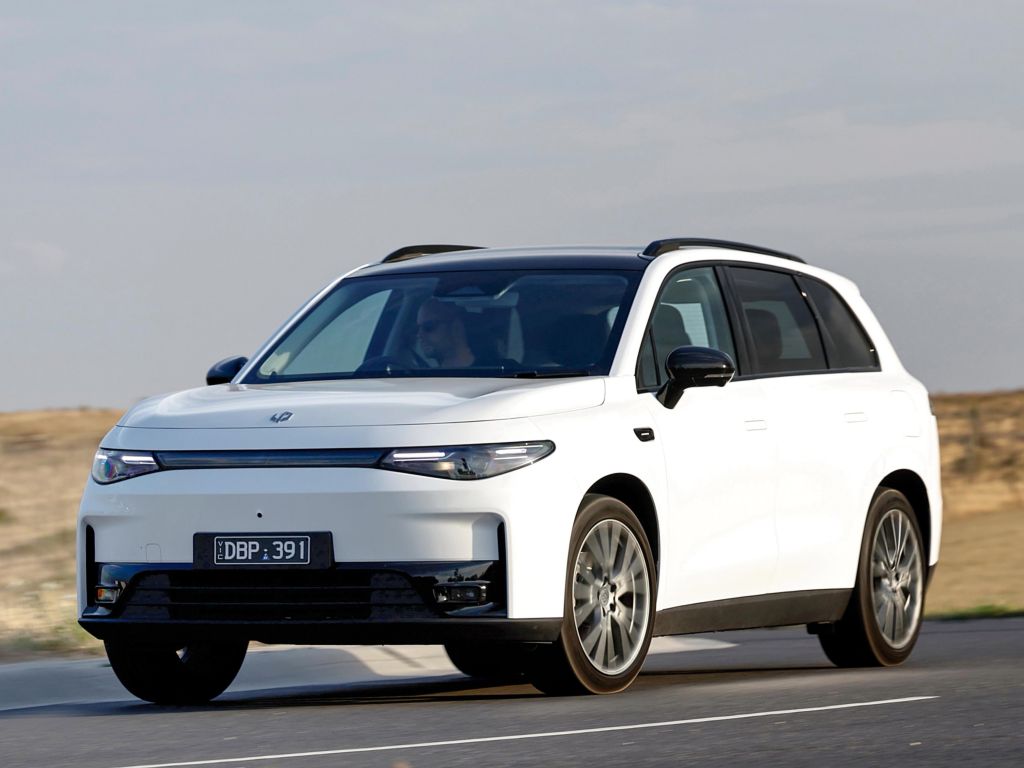
LEAPMOTOR added a range-extender electric vehicle (REV) version of its C10 SUV to the portfolio in March last year, the variant priced from $43,888 plus on-road costs in entry Style format and $47,888 + ORC for the flagship Design grade tested here.
The Chinese-built ‘C10 Hybrid EV’, as Leapmotor now describes the model, is said to combine the benefits of electric vehicles and traditional fuel cars to offer a driving range of up to 1150km (NEDC).
Imported by Stellantis Australia, the Leapmotor C10 REV combines a 1.5-litre four-cylinder petrol engine with a 158kW electric motor and 28.4kWh battery pack, offering an all-electric driving range of up to 170km.
The importer lists combined cycle fuel consumption at just 0.9 litres per 100km and CO2 emission of 21 grams per kilometre, with total system output rated to 160kW and 320Nm.
According to the manufacturer, the Leapmotor C10 REV operates primarily as an electric vehicle, with the electric motor driving the wheels. When the battery charge gets low, the internal combustion engine (ICE) generates electricity, recharging the battery and extending the driving range.
The model offers both AC and DC charging, the latter allowing a 30-80 per cent recharge in approximately 18 minutes.
For entry-grade Style variants, the Leapmotor C10 REV offers standard equipment highlights including 18-inch alloy wheels, LED headlights, heated wing mirrors, a fixed glass panoramic roof, dual-zone climate control, cloth upholstery, and powered front seat adjustment.
Infotainment technology includes a 10.25-inch digital instrument panel, 14.6-inch infotainment screen, wireless device charging pad, 12-speaker sound system, Leapmotor connected services, dual-zone voice recognition, and more.
The model offers 546 litres of cargo space in five-seat mode, expanding to 1375 litres all told.
Leapmotor says the C10 features as many as 26 storage compartments throughout the cabin.
Stepping up to the Design grade we find 20-inch alloy wheels, a powered tailgate, rear privacy glass, silicone leather upholstery, ventilated and heated front seats, a heated steering wheel, LED rear light bar, air quality monitor, and multi-coloured LED ambient cabin lighting.
Five paint colour options are available including Pearl White, Terra Grey, Jade Green, Metallic Black, and Midnight Grey.
With up to 17 ADAS functions, and seven airbags, the Leapmotor C10 REV includes as standard adaptive cruise control, autonomous emergency braking, blind-spot monitoring, door open warning, driver attention warning, emergency lane keep, forward and rear collision warning, lane centring control, lane departure warning, rear cross-traffic brake, and more.
As with the remainder of the C10 range, the REV variants are backed by a six-year/150,000km vehicle warranty, eight-year/160,000km high-voltage battery warranty, eight-year roadside assistance coverage, and eight-year capped-price servicing program.
Service intervals are set at 12 months or 10,000km, whichever occurs first.
Driving Impressions
The Leapmotor C10 REV is, on the whole, a better proposition than the battery electric C10 we drove earlier.
That car felt rudimentary in a lot of ways and did not inspire us to recommend it, particularly when there are still better options available for the money. But the range-extender version is a different kettle of fish…
There is more going for this car, especially considering the way Australians tend to use their vehicles, and particularly for those who drive long distances.
Its drivetrain is, for the most part, smooth and progressive in its power delivery. It is not exactly rapid, and while more than adequate around town and on the highway, it shows itself to be lagging behind some contemporaries when asked to really hustle.
Overtaking performance is not the quickest, and with a full complement of people on board, performance can feel a little lacklustre.
Most people will not mind – and for most of our time with the car, neither did we – but do not expect the world. It certainly does not offer the acceleration of a similarly priced pure electric vehicle in this segment.
The suspension is interesting. It is tuned toward the firmer side, seemingly compensating for the weight of the vehicle, which is carrying a battery, electric motor, petrol engine and associated hardware.
It is expectedly heavier than a pure petrol vehicle of this size, though not so firm that we would call it uncomfortable.
There is a little jostle over particularly lumpy surfaces, but around town it is not much of a bother. The suspension controls body roll, squat, and pitch very well, so there are no real issues dynamically. It simply feels a little edgier than a lighter, purely petrol-powered vehicle.
The steering is a little artificial, as expected, but points accurately and is well geared, with decent assistance in most situations. It is a pleasure to live with around town and very easy to park, though it ultimately lacks the road feel Australian buyers tend to preference.
The brakes are also a little edgy, with progression that feels short and a pedal that can be too quick to meter out a harder stop than is preferable, even with the settings adjusted to a softer mode.
It is something you learn to drive around, and after a few days you become accustomed to managing the pedal accordingly.
Mechanically, the C10 REV is very quiet. There is a fair bit of road noise and some tyre rumble, along with a few plastic rattles and other noises from inside the cabin, but the driveline itself is pleasingly subdued.
Less pleasing is the screen-biased HMI. Although it presents well, it is convoluted and somewhat distracting to use on the move.
Basically, all the car’s controls are carried through the screen, and the steering wheel spoke buttons, whose functionality changes depending on which menu screen you are in and what function you are currently adjusting.
It takes time to get used to, and having to delve through screen menus for simple tasks such as adjusting the wing mirrors is particularly annoying. The lack of wireless Apple CarPlay is another frustration.
Equally annoying is the uptight ADAS calibration.
As we mentioned with the C10 EV, this vehicle is over-regulated in its lane keeping assistance. Unless you are welded to the centre of the lane, whether in a straight line or around corners – which is neither possible nor practicable all the time – warnings quickly follow.
Perform a head check or look behind you at an obtuse intersection and the driver alert system goes off. Look at the screen and it goes off again. Of course, because so many functions are screen-based, you often need to look at the screen to operate the car.
The stereo system is decent, and the wireless charging pad works very well. The HVAC system is quiet and subtle in its operation, though the vents are not as directional as expected. They seem set up more for bringing the cabin to, and maintaining, an ambient temperature than for directing air at your face or hands.
We are uncertain how well that will work in Australia’s hotter months, but during our time with the vehicle in cooler conditions – low teens and high single-digit temperatures – the system managed cabin climate very well. The heated steering wheel and heated seats are a very nice accompaniment.
Ergonomically, the seating position is reasonably sound. The seat base itself is perhaps a little long for drivers with shorter thighs; at 174cm, this tester found it just a touch too long, with knees not falling over the edge of the seat in exactly the right position. It is not a big deal, but something likely to be noticed on longer trips.
Otherwise, the seat is well supported and offers the right levels of adjustment, as does the steering column. It is set at a height that offers a good view around the car, excluding the view through the C- and D-pillars, which, like many modern medium SUVs, hinders rear three-quarter visibility.
Rear seat room is generous, with plenty of space and well-contoured seating. Two adults will fit very comfortably, and three children should have no issue. The seats fold 60:40 to extend boot space, making the C10 REV a practically sized and accommodating family SUV.
We are on the fence with the NFC card used to access and start the vehicle.
Owners will have access to the app, of course, so the card may not become a bother, but juggling it, walking to the mirror to open the tailgate, and placing it on the mobile phone charger every time you want to start the car is tedious.
There are far better ways to do this, a proximity key being one of them. In short, the NFC card feels like a gimmick that reinvents the wheel for no good cause.
On the important question of range and electricity usage, the C10 REV is interesting.
Distance to empty showed in the high 880km range on a mix of battery and petrol-electric driving across the week. The curious thing, however, is that the individual consumption averages do not quite add up…
The petrol engine indicated 6.6 litres per 100km during our complete loan, while average energy consumption between charges sat at a rather high 28.4kWh per 100km. Given the smaller fuel tank and battery, it is difficult to figure out how the vehicle manages the kind of range it does.
We are not sure how it does it, but we are certainly not arguing that it does, because we put plenty of kilometres on the vehicle and it achieved that range without any special consideration given to economical driving.
It will be curious to see how the sales split pans out between C10 battery electric and range-extender buyers.
It will also be interesting to see whether Leapmotor takes some of this feedback on board, particularly around HMI, ADAS calibration, and NFC card access, and improves the vehicle in the generations ahead.
For now, the C10 REV is not perfect, but it is far more convincing than its battery-electric sibling. It is smooth, quiet enough, practical, and genuinely useful for Australian conditions, even if its interface, driver assistance systems, and some dynamic details need refinement.
 Read more18th of June 2026  Leapmotor introduces C10 Design Long-RangeBattery electric Design Long-Range joins Leapmotor C10 range priced from $49,8889th of June 2026  Leapmotor adds B10 Hybrid to rangeTwo-variant Leapmotor B10 Hybrid available this month priced from $37,888 + ORC24th of March 2026  Sportier Leapmotor C10 AWD headed Down UnderLeapmotor to introduce C10 AWD Sports+ Special Edition next month from $53,88820th of February 2026  Over-the-air update for Leapmotor B10Leapmotor B10 OTA update adds smartphone mirroring, one-pedal driving, ADAS tweaks |
OptionsClick to share
|


 Alfa Romeo
 Abarth
 Audi
Audi Aston Martin
 BMW
BMW Bentley
 Ferrari
 Chevrolet
 Ford
Ford Fiat
Fiat GWM
GWM Foton
Foton Hyundai
 Honda
Honda Jaguar
 Isuzu
Isuzu Kia
Kia Jeep
Jeep Land Rover
 Lamborghini
 Maserati
 Lexus
Lexus McLaren
 Mazda
Mazda MG
MG Mercedes-Benz
 Mitsubishi
 Mini
Mini Peugeot
 Nissan
 Ram
Ram Porsche
 Rolls-Royce
 Smart
Smart Skoda
Skoda Suzuki
 Subaru
 Toyota
 Tesla
Tesla Volvo
Volvo Volkswagen
 Zeekr
Zeekr

Connect with us


Facebook Twitter Instagram